
Your cart is currently empty!
The History of the Anzac Biscuit: A Taste of Australia’s Wartime Past
In my opinion, no biscuit comes close to the humble Anzac biscuit in its association with the histories of Australia and New Zealand. Made from rolled oats, flour, sugar, butter and golden syrup, these golden, slightly chewy biscuits have become a familiar part of Australian life. They appear in bakeries, on supermarket shelves and in home kitchens, particularly in the lead-up to Anzac Day on 25 April.
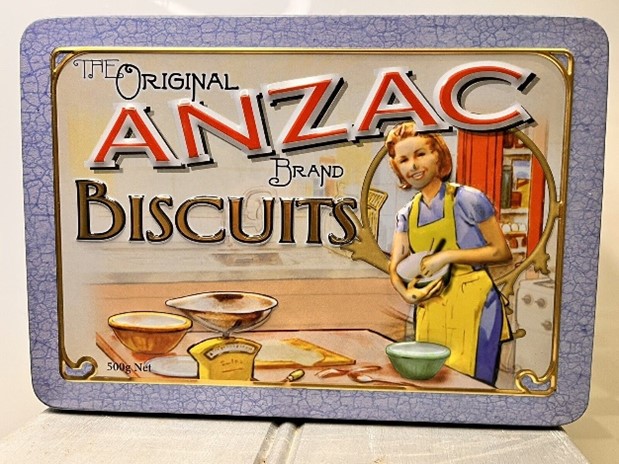
RSL Australia has released official limited-edition commemorative Anzac biscuit tins every year since 1998. These tins are available at major supermarkets, including Coles, Woolworths and Aldi. Profits from the tins support programs for Australian veterans and their families through the Returned and Services League of Australia.
When World War I began in 1914, thousands of men from Australia and New Zealand volunteered for military service. Many left their homes, families and communities to serve abroad, fighting in campaigns in Palestine, Egypt and Gallipoli, as well as on the Western Front.
For families left behind, the war brought uncertainty and worry. Mothers, wives, sisters and sweethearts sought ways to support the men serving overseas. Across the country, people baked Anzac biscuits at home and sold them at galas and community events to raise funds for the war effort.
They were originally called ‘Soldier Biscuits’ or ‘Army Biscuits’ before being renamed Anzac Biscuits (Australian and New Zealand Army Corps) following the 1915 Gallipoli landing.
The common story holds that Anzac biscuits were baked and sent to soldiers at Gallipoli. The true origins of sending the biscuits during WW1 are uncertain. By WWII, the modern recipe featured rolled oats, golden syrup, butter and coconut, and it began appearing in Australian cookbooks in the 1920s. Soldiers received the biscuits in repurposed airtight tins, such as golden syrup tins.
Anzac Biscuit Recipe
The popular Anzac biscuit is a traditional, eggless sweet biscuit. Early recipes did not include coconut.
The following recipe (without coconut) was published in The Capricornian (Rockhampton, Queensland) on Saturday 14 August 1926.
Ingredients
- 2 cups rolled oats
- ½ cup sugar
- 1 cup plain flour
- ½ cup melted butter
- 1 tbsp golden syrup
- 2 tbsp boiling water
- 1 tsp bicarbonate of soda (add a little more water if the mixture is too dry)
Method
- Combine dry ingredients
- Mix golden syrup, boiling water and bicarbonate of soda until they froth. Add melted butter.
- Combine butter mixture and dry ingredients
- Drip teaspoons of mixture onto a floured tray, allowing room for spreading
- Bake in a slow oven
The Country Women’s Association of New South Wales Calendar of Cake and Afternoon Tea Delicacies: A Recipe for Each Day of the Year (Sydney: The Association, 1933) featured two Anzac biscuit recipes, one without coconut and another with coconut.
Anzac biscuits, No. 2
Ingredients:
- 1 cup each of rolled oats, sugar and coconut
- 1 tablespoon syrup
- ¾ cup flour
- 2 tablespoons butter
- 1 teaspoon bicarbonate of soda (dissolved in 2 tablespoons boiling water)
Method
- Melt butter
- Add syrup to the dissolved soda and water. Combine with melted butter.
- Mix dry ingredients and stir in liquid
- Place small balls on a buttered tray and bake in a moderate oven
- Lift out carefully with a knife while they are still soft, then leave until cold
A family history question to consider: Did your ancestors serve in the First or Second World War, volunteer on the home front, or grow up in a household where they baked Anzac biscuits? A family recipe, an old photograph, or a handwritten cookbook might help uncover another small piece of your family’s story.
Further research
Australian War Memorial – information on the Anzac tradition and Australia’s wartime experience, includes photographs, letters and personal records that help bring individual wartime experiences to life.
National Museum of Australia – historical collections and articles on Australian food and social history.
Trove – Can you find an ancestor on the free online platform and database managed by the National Library of Australia?
The Anzac biscuit is more than a recipe; it connects modern kitchens with a time when families faced the uncertainty of a world at war. Its history reminds us that the past is not found only in battlefields, memorials and official documents. It can also be found in the ordinary and traditions that are part of our families’ past.
Did your ancestors serve in the First World War, or volunteer on the home front? Do you have a family recipe or handwritten cookbook with an Anzac biscuit recipe in it? We would love to hear your story.