
Your cart is currently empty!
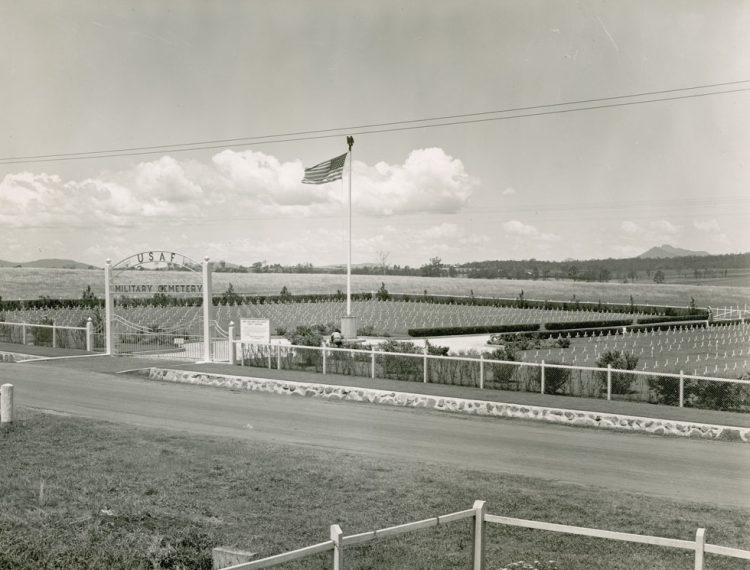
During the dark days of World War II, the USAF Military Cemetery at 19 Cemetery Road, Raceview, Ipswich, became the final resting place for many American soldiers who lost their lives on Australian soil. Their sacrifices and the subsequent efforts to honour their memory tell a poignant story of international cooperation, respect, and shared grief.
The USAF Military Cemetery, located at 19 Cemetery Road, Raceview, Ipswich, holds a significant place in history. Established in 1942, during the tumultuous times of World War II, this cemetery was a resting place for members of the United States Armed Forces (USAF).
The cemetery is located about 200 metres east of the Ipswich General Cemetery and is now known as Manson Park. This transformation from a military cemetery to a park is a testament to changing times and the need to preserve memories while adapting to the present.
A notable fact is that a photograph taken before 1947 shows the USAF Military Cemetery in its prime, as seen below. This image serves as a poignant reminder of the sacrifices made during the war and the bond shared between Australia and the United States source.
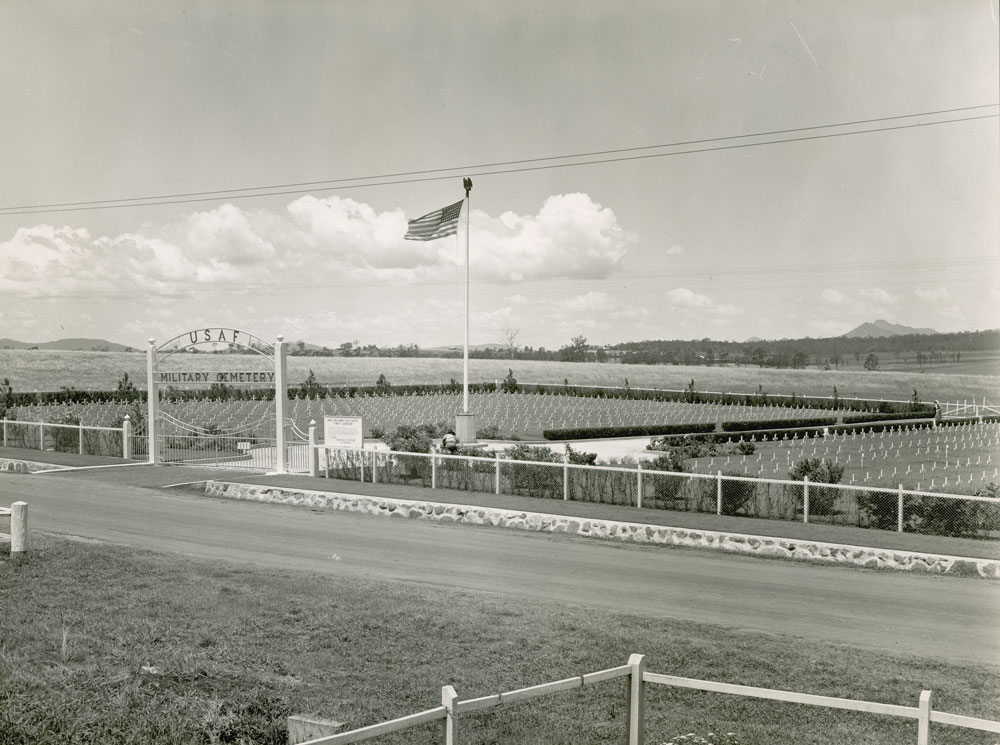
The USAF Military Cemetery in its prime
Initial Interments and the Journey Home
During the war, Americans who tragically lost their lives in Australia were initially buried in local cemeteries. In 1947, a significant operation was undertaken to exhume these bodies from various locations across Australia. They were temporarily reinterred at two primary locations: the USAF Cemetery at Ipswich and Rookwood Cemetery in Sydney. The ultimate goal was to repatriate these fallen heroes to their homeland.
This massive operation employed 190 Australian civilians, primarily cane cutters, to exhume the bodies in Ipswich. To ensure privacy and respect for the deceased, a four-metre-high canvas fence was erected around the cemetery. The workers were given strict instructions to maintain decorum throughout the process.
The 9105th Technical Service Unit’s Role
The American spring of 1947 saw the establishment of the 9105th Technical Service Unit, specifically designed to handle disinterments in Hawaii and the Pacific region. Comprising eight Field Operating Sections, the unit was dispatched to various locations, including Brisbane, to carry out the exhumations.
The USAT Goucher Victory, an American ship, arrived in Brisbane on 17 November 1947, ready to transport the exhumed bodies back to the United States. The 9105th Technical Service Unit, together with American civilian workers, swiftly set up operations, and exhumations began on 25 November 1947.
Challenges and Triumphs
The operation faced numerous challenges. The Grave Registration planners hadn’t accounted for the region’s wet weather, which created difficult working conditions. The high water table and thick clay further complicated exhumation. Despite these hurdles, the task of removing bodies from both Rookwood and Ipswich was completed by 20 December 1947.
A Solemn Farewell
On 22 December 1947, Brisbane City Hall served as the backdrop for a solemn ceremony honouring the American dead. A procession carrying a coffin containing an unknown American soldier moved through Brisbane’s King George Square. The event, witnessed by about 30,000 Brisbane residents, culminated in a touching ceremony at Newstead Wharf.
Afterwards, the caskets containing the remains of US servicemen departed Brisbane aboard the USAT Goucher Victory, eventually making their way to Hawaii.
The Legacy of Manson Park
Today, the cemetery is known as Manson Park, named in honour of Mrs Rose Manson. This local resident took it upon herself to care for the graves during the war and wrote heartfelt letters to the families of the deceased. Her dedication stands as a testament to the bond between nations in difficult times.
Captain J.B. Harris, the officer in charge of the US War Graves Unit, expressed his gratitude to the Ipswich Cemetery Trust for providing a temporary resting place for the American soldiers before their final journey home.
The USAF Military Cemetery at Ipswich stands as a symbol of shared history, sacrifice, and the enduring bond between nations. Efforts to honour and repatriate the fallen highlight the deep respect and cooperation between Australia and the United States. The legacy of Manson Park and the memories it holds ensure that the sacrifices will never be forgotten.
Do you have a story about an ancestor who was an American serving in Australia during World War II? We would love to hear from you.